
Keyboard Piano Chart
The pattern of black keys in twos and threes is the map of every piano keyboard. This interactive chart labels every key on 25-, 37-, 49-, 61-, 76- or 88-key keyboards with its note name, octave number and pitch, marks middle C, and plays each note when you click it. Print the note strip at true size to sit behind the keys while you learn.
- Free to use
- No sign-up
- Runs in your browser
Interactive keyboard chart
Click a key to hear it and see its details.
Piano Learning Printables
Printable 88-key note chart, a grand staff to keyboard chart, blank keyboard worksheets for note-naming practice with answers and a piano practice log.
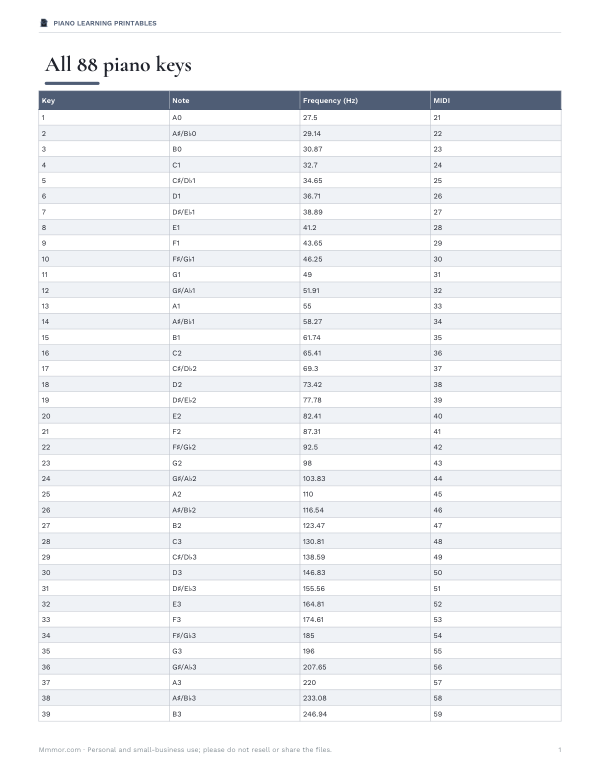
- 88-key chart (PDF/XLSX)
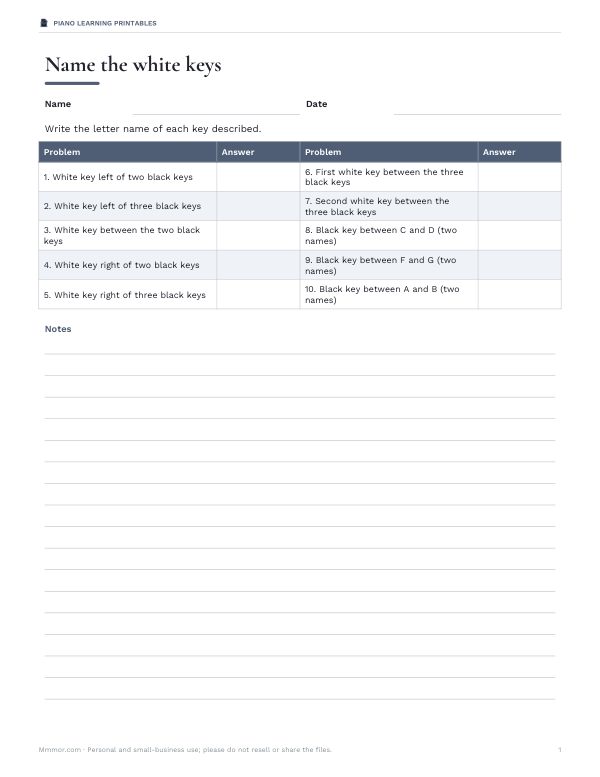
- Note-naming worksheet (PDF, DOCX)
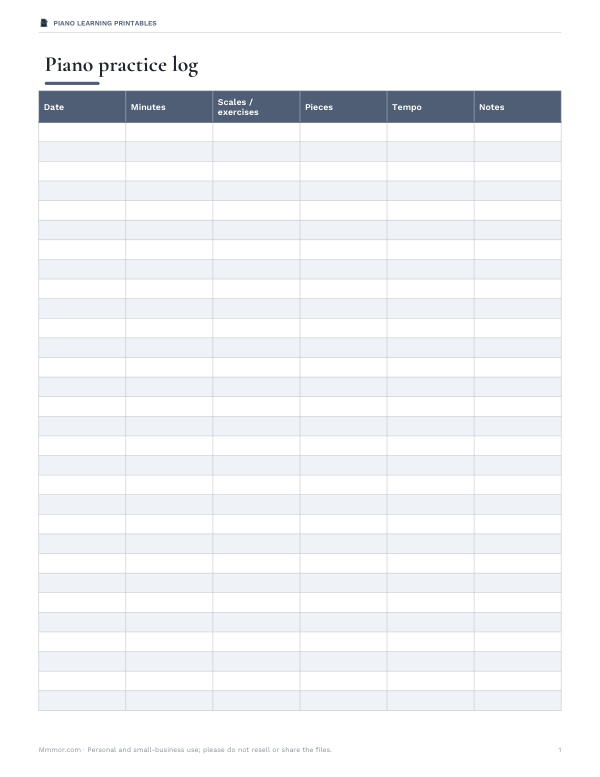
- Practice log (PDF/DOCX/XLSX)
Formats: PDF, XLSX, DOCX. Instant download after payment (link valid 72 hours, up to 5 downloads). AI-assisted: the templates were drafted with AI help and reviewed and laid out before publishing.
$3.00 USD, one-time 3 files · about $1.00 each
- Instant download
- 7-day refund
- Secure checkout by Stripe
7-day money-back guarantee. Full refund within 7 days of purchase, even after you download.
Full refund within 7 days — see the refund policy and license.
Free printables
Single sheets you can print right now, no sign-up. The full pack adds every sheet in one download plus the editable files.
How the keyboard is laid out
A piano keyboard repeats the same pattern of 12 keys — seven white and five black — in every octave. The black keys come in groups of two and three. The white key just to the left of any group of two black keys is C; the white key to the left of a group of three is F. From C the white keys run C, D, E, F, G, A, B and back to C. Once you can find C, you can find every note.
Octave numbers and middle C
| Note | Name | Frequency | Key number (88-key) |
|---|---|---|---|
| A0 | Lowest key on an 88-key piano | 27.50 Hz | 1 |
| C1 | Lowest C | 32.70 Hz | 4 |
| C4 | Middle C | 261.63 Hz | 40 |
| A4 | Concert pitch A (tuning note) | 440.00 Hz | 49 |
| C8 | Highest key | 4186.01 Hz | 88 |
In the most common naming system (scientific pitch notation) each octave number starts on C, so the B just below middle C is B3. Middle C is roughly in the middle of an 88-key piano and usually close to the brand name on the fallboard.
Sharps, flats and black keys
Each black key has two names. It is a sharp (♯) of the white key to its left and a flat (♭) of the white key to its right: the black key between C and D is both C♯ and D♭. Which name you use depends on the key signature of the music. Some white keys have “enharmonic” names too — E♯ is the same key as F, and C♭ is the same as B — which appear in certain keys.
Keyboard sizes
| Keys | Range on this chart | Octaves | Typical use |
|---|---|---|---|
| 25 | C3–C5 | 2 | Portable MIDI controllers |
| 37 | C3–C6 | 3 | Compact controllers, synths |
| 49 | C2–C6 | 4 | Beginner keyboards, controllers |
| 61 | C2–C7 | 5 | Most home keyboards |
| 76 | E1–G7 | about 6¼ | Stage keyboards |
| 88 | A0–C8 | 7¼ | Acoustic pianos and digital pianos |
Smaller keyboards often have octave-shift buttons, and manufacturers do not all start on the same note, so check the lowest key on your instrument.
Using the interactive chart
- Choose your keyboard size so the chart matches the number of keys you have.
- Pick labels: note names with octave numbers, plain letters, or solfège.
- Click a key to hear it and see its frequency, MIDI number and position.
- Middle C is highlighted in yellow.
- Print the full chart for reference, or print the true-size strip to place behind your keys.
Printing a note strip that fits your keys
Most full-size keyboards and pianos have white keys about 23.5 mm (just under an inch) wide, so an octave spans about 165 mm. The true-size strip is drawn at that width, a few octaves per landscape page. Print at 100% scale, check one octave with a ruler, cut the strips and tape them together, then stand the strip behind the keys with each label above its key. Some compact keyboards have narrower keys; if yours does, use the regular chart instead.
Worked example: finding notes
On a 61-key keyboard, the lowest key is C2. Middle C (C4) is two octaves up: count 14 white keys from the left end (7 per octave) and you reach C4 as the 15th white key — it is the 25th key counting black keys too. Pressing it here shows 261.63 Hz and MIDI note 60. The A above it, A4, is 440 Hz: the note orchestras tune to.
Grand staff and the keyboard
Middle C sits on the ledger line between the treble and bass staves. Notes on the treble staff are usually played by the right hand above middle C, and bass staff notes by the left hand below it. The lines of the treble staff from bottom to top are E4, G4, B4, D5 and F5; the bass staff lines are G2, B2, D3, F3 and A3. Linking each staff position to a key on this chart is the fastest route to sight-reading.
Keys, weight and action
Full-size keyboards use the same key width as acoustic pianos, but key feel varies: unweighted synth-action keys are light, semi-weighted keys add some resistance, and hammer-action keys imitate a piano’s heavier bass and lighter treble. For piano lessons, most teachers recommend 88 weighted keys; for music production and portable use, 49- or 61-key controllers are common.
Learning tips
- Find all the Cs on your keyboard, then all the Fs, using the black-key groups.
- Say note names out loud as you play a scale.
- Take the labels away as soon as you can — practise with “No labels” to test yourself.
- Learn the notes on the staff at the same time, so reading and playing connect.
AI-assisted content
This page was drafted with AI assistance and reviewed before publishing. Frequencies use standard equal temperament with A4 = 440 Hz.
Frequently asked questions
How many keys does a piano have?
88: 52 white and 36 black.
Where is middle C?
C4, the 40th key on an 88-key piano, near the middle of the keyboard.
How do I find C on a keyboard?
It is the white key just left of each group of two black keys.
What is the frequency of A4?
440 Hz, the standard tuning pitch.
Is C♯ the same as D♭?
On a piano, yes — they are the same black key.
Can I print the keyboard chart?
Yes, print the full chart or a true-size strip for behind the keys.
What is the lowest note on a 61-key keyboard?
Usually C2, though some models start on a different C.